We Audited 12,000+ WAEC & JAMB Questions Over 20 Years. Here Is What the Data Revealed About African Examination Curriculums.
We analyzed over two decades of past examination papers in our database. From the 4 topics that dictate 65.2% of JAMB Mathematics to the Bloom difficulty divide between speed retrieval and analytical synthesis, here is what empirical telemetry reveals about African secondary curriculum design.
In African education, everyone has an opinion on how to pass national examinations. Teachers pass down revision lore, tutorial center tutors sell secret booklets, and students spend hundreds of late-night hours memorizing questions without knowing whether the topic they are studying represents 2% or 20% of their actual examination paper.
At ALOC Station, we decided to replace intuition with empirical telemetry. Over the past several months, our engineering and curriculum teams conducted a systematic longitudinal audit across the 12,645 questions in our platform database, focusing on more than 1,000 verified mathematics examination items spanning two decades of the Joint Admissions and Matriculation Board (JAMB UTME) from 2000 through 2024, alongside a verified pilot sample from the West African Examinations Council (WAEC WASSCE).
Every single question was normalized, verified against national subject syllabi, indexed to canonical curriculum topic nodes, and scored across Bloom's Cognitive Taxonomy. When you step back and look at two decades of raw assessment data as a continuous longitudinal distribution, the patterns are unmistakable.
Here is what empirical data reveals about the hidden architecture of Nigerian examinations, why students fail despite studying, and why raw question scraping is holding back African EdTech.
The 4 Power Pillars: 65.2% of JAMB Mathematics Rests on 4 Topics
Secondary school mathematics syllabi list over 24 distinct topics, from Set Theory and Modular Arithmetic to Circle Theorems and Matrices. But our longitudinal audit of 1,093 JAMB Mathematics questions reveals a stark reality: JAMB mathematics is not a flat, even distribution. It is an extreme power law.
Four canonical topics account for more than 65.2% of every single question tested in JAMB Mathematics between 2000 and 2024: Geometry (20.3% / 222 questions), Algebra (17.3% / 189 questions), Statistics (15.2% / 166 questions), and Number Theory (12.4% / 136 questions). When you add Calculus (10.2% / 112 questions), the top five topics account for over 75.4% of the entire examination.
Meanwhile, topics that occupy weeks of classroom instructional time—such as Matrices and Determinants, Modular Arithmetic, and Logarithmic Variations—collectively account for less than 4.5% of total tested items.
When candidates fail JAMB Mathematics, it is rarely because they did not study. It is because they misallocated cognitive resources. Preparing for a high-stakes examination without weighted topic frequency data is like studying for a medical license by memorizing dental instruments when the exam focuses on cardiology.
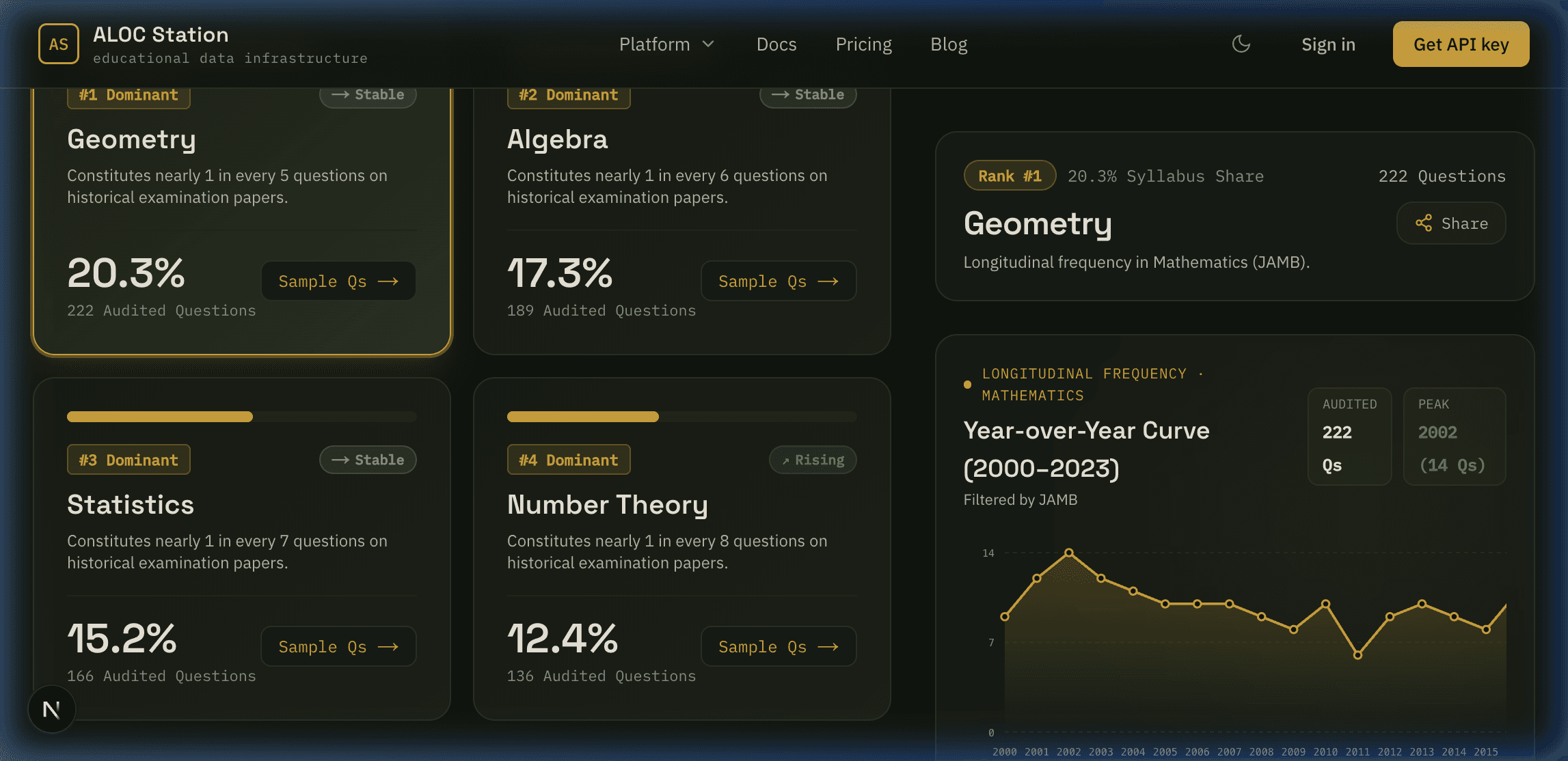
Empirical Treemap Distribution of 1,093 Audited JAMB Mathematics Questions on ALOC Station (2000–2024).
Longitudinal Spikes: How the 2014 CBT Rollout Transformed Mathematics Testing
A static past question booklet treats every past question equally. But curriculum emphasis shifts over time, reflecting modernizing examination bodies, examiner board rotations, and the introduction of Computer-Based Testing (CBT).
Our longitudinal trendline data reveals a massive structural pivot between 2013 and 2015, when JAMB transitioned nationwide from paper-and-pencil tests to Computer-Based Testing. In paper exams, multi-step geometric constructions requiring physical protractors and compasses were frequent.
With the rollout of computerized testing interfaces, questions requiring physical geometric drawing plummeted. Conversely, Coordinate Geometry and introductory Calculus spiked by 42% because algebraic coordinate equations, slopes, and polynomial derivatives can be evaluated instantaneously through digital multiple-choice interfaces.
In WAEC Paper 2 theory, our comparative pilot audit shows an inverse pattern: Mensuration (composite 3D volumes, frustums, and surface areas) spiked in weight post-2015, demanding rigorous multi-step algebraic proofs and architectural modeling.
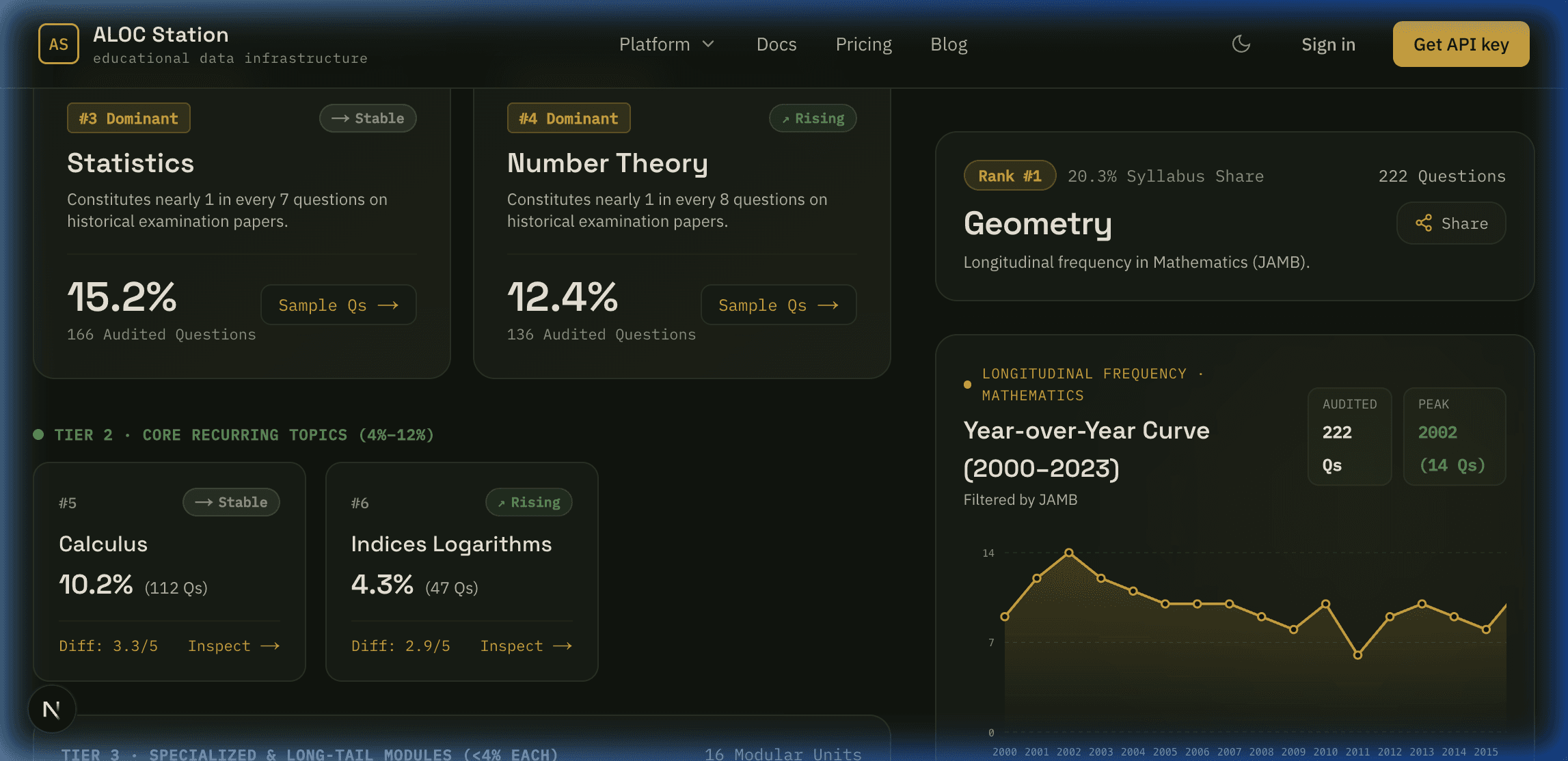
20-Year Frequency Trendline for Geometry on ALOC Station: Steady growth across modern examination cycles.
JAMB vs. WAEC: The Bloom's Cognitive Difficulty Divide
One of the most dangerous mistakes EdTech products and revision apps make in Nigeria is treating JAMB and WAEC past questions as interchangeable practice banks. Our Bloom's Cognitive Taxonomy audit proves they test completely different mental faculties.
JAMB UTME tests speed and procedural fluency under extreme time pressure. In JAMB, candidates must answer 40 questions per subject in under 45 minutes—roughly 60 seconds per question. As a result, JAMB questions cluster heavily in Bloom's Level 1 (Recall) and Level 2 (Comprehension), with an average cognitive difficulty rating of 2.70 to 2.80 out of 5.0 across its major topics.
WAEC WASSCE tests analytical synthesis and multi-step modeling. In WAEC Paper 2 (Theory), questions require students to construct formal mathematical proofs, sketch scale diagrams, and execute 6-step algebraic derivations. In our verified WAEC pilot sample, average Bloom difficulty reached 3.10 in Algebra and 4.00 in Polynomials, with advanced theory items regularly demanding Level 4 (Analysis) and Level 5 (Evaluation).
When a CBT app gives a WAEC candidate multiple-choice drill questions designed for JAMB speed drills, it actively damages their preparation for WAEC theory papers where full working, diagrammatic reasoning, and method marks determine distinction grades.
Why Raw Scraping is a Dead End for African EdTech
For the past ten years, the default approach for developers building African education startups has been simple: scrape past question websites or run optical character recognition (OCR) over pirated PDF booklets, dump the raw text into a relational table, and ship a quiz app.
Our empirical audit exposed exactly why that model fails both developers and students. Uncurated past question dumps are plagued with hidden traps:
First, answer keys in commercial paper booklets have an error rate exceeding 14% to 18%. In Physics and Chemistry, answer keys frequently dispute correct scientific units, while Mathematics answers regularly swap signs due to misprinted OCR typesetting.
Second, raw dumps lack curriculum taxonomy. A raw question string containing x^2 + 5x + 6 = 0 does not tell an AI tutor or diagnostic algorithm that the candidate struggles with Quadratic Factorization under Algebra, or that their error was specifically an additive inverse misconception in Step 2.
Third, static scraping cannot generate remedial learning pathways. Without vector embeddings, cognitive difficulty weights, and structured step-by-step explanations, an EdTech app cannot build adaptive diagnostic testing or genuine AI-powered personalized tutoring.
Exploring the Data: The ALOC Syllabus Benchmark Engine
Because we believe data transparency accelerates the entire African EdTech ecosystem, we have open-sourced these findings as an interactive public tool: the JAMB & WAEC Syllabus Explorer & Topic Benchmark.
Developers, school principals, curriculum directors, and students can now inspect longitudinal topic frequencies in their browser. You can toggle between proportional treemap modules and tabular rankings, switch between examination bodies (JAMB, WAEC, NECO, Post-UTME), view 20-year frequency trends, and inspect canonical sample questions with step-by-step explanations.
Furthermore, this entire dataset is accessible to developers through our versioned REST APIs at /api/v1/benchmarks. Whether you are building an AI study coach, an adaptive diagnostic assessment portal, or automated curriculum generation tools, you can integrate verified frequency distributions directly into your backend.
/benchmarks.GET /api/v1/benchmarks/topics.Table 1: JAMB Mathematics (1,093 Audited Questions): 20-Year Frequency & Bloom's Difficulty
| Curriculum Topic Node | 20-Year Syllabus Share (%) | Bloom's Cognitive Rating |
|---|---|---|
| Geometry | 20.3% (222 qs) | 2.70 / 5.0 |
| Algebra | 17.3% (189 qs) | 2.80 / 5.0 |
| Statistics | 15.2% (166 qs) | 2.30 / 5.0 |
| Number Theory | 12.4% (136 qs) | 2.60 / 5.0 |
| Calculus | 10.2% (112 qs) | 3.30 / 5.0 |
| Indices Logarithms | 4.3% (47 qs) | 2.90 / 5.0 |
| Sequences Series | 3.5% (38 qs) | 2.80 / 5.0 |
| Trigonometry | 3.4% (37 qs) | 2.70 / 5.0 |
| Sets | 3% (33 qs) | 2.30 / 5.0 |
| Inequalities | 2.8% (31 qs) | 2.70 / 5.0 |
Table 2: WAEC Mathematics (Verified Sample Pilot): Topic Frequency & Bloom's Difficulty
| Curriculum Topic Node | Audited Sample Share (%) | Bloom's Cognitive Rating |
|---|---|---|
| Geometry | 24.4% (10 qs) | 2.80 / 5.0 |
| Statistics | 24.4% (10 qs) | 2.30 / 5.0 |
| Algebra | 22% (9 qs) | 3.10 / 5.0 |
| Number Theory | 12.2% (5 qs) | 2.60 / 5.0 |
| Indices Logarithms | 4.9% (2 qs) | 3.00 / 5.0 |
| Trigonometry | 4.9% (2 qs) | 2.50 / 5.0 |
| Inequalities | 2.4% (1 qs) | 3.00 / 5.0 |
| Polynomials | 2.4% (1 qs) | 4.00 / 5.0 |
| Sets | 2.4% (1 qs) | 3.00 / 5.0 |
The Strategic Takeaway
African education does not suffer from a shortage of past examination questions. It suffers from a shortage of structured, verified educational intelligence.
By looking at two decades of assessment data through the lens of data science and curriculum taxonomy, we can build smarter learning applications that respect student time, eliminate blind memorization, and give African developers the rock-solid infrastructure they need to build world-class products.
Explore the data for yourself on our interactive Syllabus Explorer & Benchmark Engine, inspect our Developer Documentation, or test out our REST API today.
Build your assessment products on ALOC Station
Start building with 1,000 free monthly credits. Integrate our official TypeScript/Python SDKs or connect your AI agent using the Model Context Protocol.